I was paging through the October Smithsonian Magazine and came upon a black and white snapshot and accompanying essay, "Salad Days" by Gore Vidal. The photo was by Karl Bissinger, taken in 1949 in a Manhattan cafe garden of five up-and-coming young artists: a ballerina, two novelists, a painter and a playwright. Besides giving background on each of the five, Vidal explicates photographer Bissinger's genius at depicting America's cultural arts rise when we weren't at war for a few years after WWII. The urban literati as photographed in 1949 "perfectly evokes an optimistic time in our history that we are not apt to see again soon."
It seems as though each generation has a time of young optimism that, when they look back at that time and tell the next generation "My generation's time was golden, times will never shine quite as brightly again."
Soon after I finished college and moved to Anaktuvuk Pass, Alaska to teach, I was hosting in my little rental log cabin, a crafts buyer from Anchorage. He who was in the village to purchase the handcrafted Anaktuvuk masks to take back to Anchorage to sell. The middle aged man was talking about Alaska, pre-statehood and was lamenting that those wilder frontier-like days were gone for good. As he talked on I had the thought, which I kept to myself, that he was actually grieving the loss of his youth more than the disappearance of the frontier. For me, the Great Land of Alaska was wilderness frontier. In my youth it was all new to me and I was just starting to make my way in creating a life and identity there. Though I listened to this craft buyer and learned a bit about life from a generation before me, I didn't grieve over what was lost from before.
Now, as I look at the future I see an increasingly dismal picture: a middle class that is diminished, a planet that is growing increasingly polluted and crowded, and changes that are bleak. Life looked better to me in the past. Then I look at my children and many other young people who are starting out in young adulthood, I see that spark of fire in their eye and optimistic energy that recalls that time when I was young and only looking forward to life's challenges; and not having any of an older Alaskan generation's swan-song about "the (better) good 'ol days."
Wednesday, October 31, 2007


Tuesday, October 30, 2007
Fall Flowers
I was a bit disappointed by the washed out colors of these flowers, which may be from using a flash...
Pink Turtle Head

Pink Turtle Head

Winter Hardy Yellow Mums

Maroon Winter Hardy Mums with Wormwood to the right and leaves of High Bush Cranberry in upper left


Sunday, October 28, 2007
Busy Weekend
I have been busy splitting up maple and apple wood for next winter's heating wood. On Saturday I helped prep lunch for the retreat that Lynn was at. Randy Little told me about the pellet stove that he bought and had installed in his house. He says that he is well satisfied with it and plans to save a lot of money on his heating bill. It sounds like a trouble-free way to go. I would wait for a pellet furnace to be developed with an extra big hopper and the blower power to hook it up to the existing duct work in our house.
My back is sore tonight. I bucked up some downed apple trees on a side slope. The wood is nice and maroon colored, dense and will be prime for heating next year.
I must get some pictures of some of the flowers that Lynn has still blooming in her flower gardens around the house and post them here.
A little snow on Friday; just a trace.

Wednesday, October 24, 2007
Last Color of Autumn
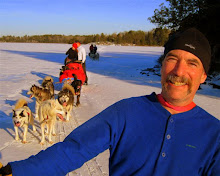
The day dawned with sleet that turned to snow for a short time. I always feel excitement about the snow, especially when it first arrives. So the excitement was brief as the snow melted as soon as it hit the firmament. Snow in the far north always meant another mode of transportation on the ground; the chance to ski and snowshoe as well as use the dog team and snow machine. When living elementally some things are easier with snow. Many areas of muskeg and tundra are almost inaccessible in the summer when the wet, unstable ground and bugs are taken into consideration. Much easier to have snow fill in the sedges and uneven ground and there are no bugs to contend with. Mukluks and light, warm parkas make winter time travel with snowshoe or ski a delight.
But we're still not there yet in the Copper Country. Still a lot of autumn to meander through before the snows get deep around here!
The wind has stripped most of the leaves from the trees, but as this picture shows, the cherry trees still have a bit of orange foliage and the burning bush is in full color. The tall aspen are mostly stripped of leaves, though a few still rattle in the wind. The sun is nearly cutting through the mist and clouds. The weather report is for some sun this afternoon, though

Tuesday, October 23, 2007
LIVING THE BASICS ON THE UPPER YUKON
When my wife Lynn and I moved from Homer in south central Alaska to Eagle on the Upper Yukon to teach. We rented a little frame cabin for our first winter.The cabin was on the edge of town, had a great place for keeping the dog team and an old house trailer for storage. Secure storage for food and other supplies is a necessity in the north, in remote areas where you don't have store access to supplies. Eagle had a couple of stores where canned goods and the basics could be got... for a price, but we enjoyed home made food instead of the fare usually offered in small stores in the bush.
The rental cabin had a small oil heater in it but we were into heating with wood. My father had crated and sent up, as a Christmas present, an Ashley wood burning stove two years before. Lynn and I were then living together and beginning a life together at a rented log cabin 20 miles out of Fairbanks on Chena Hot Springs Road while she finished up getting a teaching certificate.
The cabin at Eagle that we were renting didn't have electricity so the electric blower on the Ashley stove was of no use to us. Not bad, we were thinking.. We wanted to sharpen life down to the essentials, live elementally without most of the conveniences that were always taken for granted in our childhoods. Eagle was the kind of place that is a walkable community and many people didn't own automobiles. We had an old pickup truck and a decrepit Volkswagen Beetle. When the snow came that year, both vehicles were parked for the winter, covered deeply in snow as the winter progressed. We had freighted in staple foods for ourselves and dog food for the dozen huskies that I had been raising , training and transporting from place to place since I started dog mushing in Anaktuvuk Pass. I still had my chainsaw from my days of heating and cooking with wood in the Upper Peninsula of Michigan. I hadn't had electricity even then and still had a couple kerosene lamps that would be of use in Eagle. Now I was back into the type of life that I had enjoyed then, except now I was married and sharing this life with a woman who was as excited as me about living the almost- pioneer life.We were both looking forward to the dog team getting regular use for transportation as well as hauling water and wood.
The Eagle City Well House, built in the end of the 19th century, was still in use by most of the town. Water was still pumped by the wind mill into the large redwood tank up above the hand dug well.Most people didn't have indoor plumbing and used outhouses.
My parents came up to Alaska for a visit and my father helped us move our belongings to the rental cabin. My parents were enchanted with Eagle, though my mother was not too keen on living like a pioneer. When we moved in and started school teaching we were very busy but life was full and fun. Cutting wood on Signal Tower Hill on the weekend, shooting grouse, and setting up housekeeping kept us busy. Meeting all kinds of characters in the town and out on the country, fitting into the school scene in Eagle and running the dogs out to the school, three miles from the town, this was the rhythm of our lives. The river people, young live-off-the-landers were in their heyday then. Dick Cook, Charlie Edwards, Monty Warner and a host of others were all visiting Eagle to pick up their mail and supplies before going out to their cabins and trap lines for the winter. Charlie Edwards became a good friend to me in the first year. He came around bearing gifts of salmon and then in the early winter he and I mushed out into the Seventy Mile River country, my first time traversing the trails up Boulder Creek.
By the time the spring was coming we had decided to get some land and stay in Eagle. With Dale Richert's help we found a couple of city lots for sale on the buffer zone at the edge of town. The lots were on the side hill with no access except a trace up along the city line. We would have a decent cabin site , place for a garden and the dogs could reside just over the property line in the buffer zone. I ordered a tent from Alaska Tent and Tarp, we put it on Charlie Edwards' lots in town while there was still a couple feet of snow on the ground. We had moved out of our rental cabin because, after all, we could buy the wall tent with a month's rent saved and we also wanted to live in the tent in the spring. Lynn had gotten together a high school trip to Britain, on an airline special where we could fly into London for less than a flight to Seattle. We left the tent for a 3 week period for the trip. When we came back the snow was gone and we were putting any spare moments into prepping the site for a garden and figuring out our cabin. The wall tent was a cozy abode for us with its little Yukon stove and a pole bed. The multitude of warblers and nesting robins made the woods alive with morning cheer.
We got 8 foot 2-sided cabin logs and vertical studs ordered from Mike Potts, a local trapper, homesteader and logger. We took a promising art student from Eagle Village, Howard David, with us down to Homer for a few weeks where he got instruction from a local artist, Gary Lyons. I brought Howard back to the Eagle Village, leaving Lynn in Homer for a few weeks longer while I started work on the cabin.
I was amazed that my sweet mate's garden that she had planted before we left for Homer was not only sprouted but was flourishing with no human care. Getting the logs and materials to the cabin site was accomplished with the help of John Borg, who had a large wagon and bulldozer. John also pushed out a level pad, as our plan was for a cabin that was earth bermed on 3 sides to better insulate from the cold. It tended to rain every afternoon and this watered the garden but also made building in the woods a wet misery filled with mosquitoes.
Gary Lyons had given us a log building book that had a chapter about piece en piece log building, a French Canadian method. With the materials at hand, this became our building method of choice. The building went forward. We moved in with the snow flying, still putting in windows and a door.
We had a small cast iron Vermont Castings Resolute wood stove and a wood cook stove that was in a warehouse of the Eagle Commercial Co. Lynn went into Fairbanks for building materials with the truck and surprised me by bringing back a hardwood freight racing sled that would be capacious for everything: laundry, water, wood and our first child. Lynn was pregnant! We moved up the dogs and tent and settled in for the winter. One acquaintance, Steve Nelson, said that he heard me that first winter, cutting wood with the chainsaw at night to heat the cabin. The little wood stove often had to run cherry red to heat our place in the far below zero weather. The manufacturer must have figured heated square footage based on a well insulated house in a temperate climate, not the sub Arctic. With both the wood heat and cook stoves going the cabin was extra toasty. Lynn was on a different schedule at the school. She was half-time so came back and would get the stoves going and heat the cabin as well as get food and dog food on before I got back in the late afternoon. I made a little plank komatik for her so she could mush out to the school with 3 dogs pulling her. She could sit on the low basket and be comfortable and safe. As she got larger she was concerned that she might fall off a basket sled while standing up.
As far as being out on the land in winter, both of us were well used to temperatures of 60 below and Lynn was a good seamstress of mukluks, moccasins and parkas. I had my arctic gear from living with the Inuit above the Arctic Circle.
In later years we added a porch and then a log arctic entryway on the porch to our little cabin. The wall tent gradually rotted away from the bottom up and was discarded in favor of a large two story shop. A log sauna was put in just a couple of steps below the cabin and our three kids that came along soon after the cabin was built were all used to taking their bath in the sauna. We lived in our cabin for seven years and then moved into our large log home, but that is another story.


The walls of the sauna were saddle notched and long-log-scribed for tightness. Many a relaxing evening were enjoyed in our sauna. The kids knew only the sauna as their bathing apparatus. Sometimes they would get too hot in their wash tub so we would step out onto the little porch with overhanging snow covered spruce branches and shake a branch, sending a frigid dusting of powder onto our steaming bodies! Then we would rush back into the sauna to get warm again.

Monday, October 22, 2007
Oct. 21: Cliff Drive Climb
Our seemingly constant rain pattern was broken briefly this weekend with partly sunny weather, but rain was always a threat, at least in my mind. Muir helped on Saturday with the chimney liner and this made all the difference in getting it put in. Then he went out on his motorcycle to Cliff Drive up in Keweenaw County to camp with a couple of his friends, Travis and Jay. I hooked up the new wood stove and set the first break-in fire.

Lynn and I went up to Cliff Drive on Sunday morning and found Muir's camp at a place that climbers frequent, the Ice Falls. The day was crisp and clear with the yellows and oranges of aspen and tamarack trees brightening up the landscape. The climbers' camp site was on the top of the cliffs, directly on the basalt rock shelf. The wind was blowing faily strong up on top of the 300 foot cliffs and Muir's sleeping bag had blown off onto the ledge that we were going to rappel down to. Travis set the top rope and then I went down with Muir's self-fashioned swiss climbing harness of a piece of webbing. Then Lynn went with a bit of squealing in fear. But the view was wonderful with the sun on the autumn woods after the climb up.

Muir setting carabiners in the already drilled bolts on a pretty tough rock climbing route. Travis went after him but ended up slipping and falling about 14 feet between safety points. He reacted quickly and so no harm done!


Thursday, October 18, 2007
October 18 over 151 Years
Thursday, October 18, 2001
Another rainy day, complemented by driving wind.The tree leaves are being stripped and flung afar! Hopefully the strong wind bodes well for a weather change later, with rain diminishing. A good day, at present, to sit close to home - inside.
Below is an October 18, 1856 journal entry by Henry David Thoreau that strikes a deep chord of sympathy from me, a kindred feeling across the ages. It is of man's usual absorption of interest in man alone. The theme of life is upon man's back; not the theme of life being all of life, but how an aspect of life relates only to men.
The majority of society can consider a movie star or sports figure noteworthy of their full attention and yet the natural world, which sustains our life, is only noted when it relates to man. People will all slaver after the newest consumer device, be it an "i-device", automobile or a new garment while a simple life is is not even considered as relevant. A materialistic existence with posh comfort and insulation from the natural environment, from which we are derived, leaves us self-centered. Our government at this late date begins to acknowledge the global destruction wrought by climate change and the sure effect of spewing carbon dioxide from petroleum into the atmosphere. We are all accessories to the rampant industrial materialism that is spreading on this planet. I don't see an end in sight other than the planet continuing to degrade. Only through a lifestyle change, by all or at least most, will we stave off the worst of global climate change. The carbon loading is like a massive train that is gathering speed and is soon to be runaway. A fundamentalist Christian that I know, Mike, believes that Al Gore and others of his ilk are all tools of Satan, who are diverting people away from being saved by Christ who will come again and establish a perfect world anyway. So those in the Gore camp are all just trying to postpone the inevitable end of the world. So let people live like drunken brides and industry burgeon further in this fallen and depraved world...
Mike says that the sailboat that he and his wife plan to sail around the seas, ministering to others will encounter less islands since many have been inundated by flooding from melting ice caps, but he must keep focused on Christ, because this world is just passing anyway...
Be all the above as it may be, below is Thoreau. To him, Nature is "the only real elysium" and "the life is everything." Thanks be to a sane voice in the babble:
"Men commonly exaggerate the theme. Some themes they think are significant and others insignificant. I feel that my life is very homely, my pleasures very cheap. Joy and sorrow, success and failure, grandeur and meanness, and indeed most words in the English language do not mean for me what they do for my neighbors. I see that my neighbors look with compassion on me, that they think it is a mean and unfortunate destiny which makes me to walk in these fields and woods so much and sail on this river alone. But as long as I find here the only real elysium, I cannot hesitate in my choice. My work is writing, and I do not hesitate, though I know that no subject is too trivial for me, tried by ordinary standards; for, ye fools, the theme is nothing, the life is everything. All that interests the reader is the depth and intensity of the life excited. We touch our subject but by a point which has no breadth, but the pyramid of our experience, or our interest in it, rests on us by a broader or narrower base. That is, man is all in all. Nature nothing, but as she draws him out and reflects him. Give me simple, cheap, and homely themes." H.D. Thoreau, 10/18/1856
Subscribe to:
Posts (Atom)