Tuesday, October 21, 2008

October Colors Ebbing...


What a fall color tour it has been, close to home in the UP. With so much great colors close to home, we stayed around with a few forays out a few miles. The color change seemed to keep going on much longer than usual. There has been some wind and a bit of rain this fall, but the colors prevailed.
With the presidential campaign in full-on drive, with the Republican John McCain negatively muck-raking (and not finding much) on Democrat Barack Obama, I had some time and did some volunteering at the Houghton Democratic headquarters. McCain has pulled his campaign out of Michigan for weeks now due to polls showing he has lost the state - you would never know it here in the Copper Country. Calls I've made to the older residents in the area show that conservative republican voters are alive and well in the UP.


Lynn with our 2 dogs, Gabe and Dixie, on an autumn walk.


Looking through a fiery maple to the firmament


On the 19th, a sunny Sunday morning, Lynn and I headed into Marquette for a presentation by the Will Steger Foundation on the effects of global warming in the polar regions.The presentation was sponsored by the Superior Watershed Alliance, which I've worked with a bit, learning how to test and sample for water quality of streams. SWA is a sponsor of the Will Steger Foundation. Another organization that I'm a member of is Earthkeepers and I was invited to attend a mid afternoon roundtable with Will Steger where participants would get to know him and talk with him. Lynn dropped me off at the meeting site and I was the 3rd person there. Will talked to our little group of 10 people for close to an hour about his upbringing and 64 year-old life, then he took questions and finally the meeting broke down to informality with simple talk. I had a chance then to talk to Steger about places we had in common and his life now in a houseboat on the Mississippi River.
Lynn was waiting for me in her car and we went looking for a dinner-to-go, as she wanted to have a picnic in a pile of leves at Presque Isle Park looking out on Lake Superior. The food, from Vango's was good and Greek; the large leaf windrow, formed from the wind blowing them to waist-high was soft and warm. After the picnic we drove over to Upfront and Company where the Superior Watershed Partnership meeting was being held. It went on for a long time. I was mentioned by Carl Lindquist and asked to stand as a member of the Partnership who had experience living in the arctic. One of Steger's expedition partners, who was Norwegian talked after Will's slide show on his findings on the impact of global warming. Students talked about the Energy Action Coalition, organizing that is taking place on campuses to influence the start of green industry and awareness of the need for society to change to save our planet and its biological diversity. After a panel discussion by all of the speakers, the evening was over, and we headed out of Marquette and arrived back home at a bit past 11:00.


Lynn relaxing during our Presque Isle picnic.


Will Steger in Marquette

Saturday, October 11, 2008

Autumn Already...


Spirit Tree, North Shore, Lake Superior, Minnesota

What a busy summer it's been! I seldom had time to even think about this blog, but now I will have a bit of time to write, or at least the state of mind to do so. Since my blog is basically to me, I don't feel compelled to write in it regularly. If there is anyone out there who has ever checked this, all I can say is sorry for your futile bother... In looking at my list of posts I noticed that I didn't ever post some in May, simply left them in a saved state. I'll remedy that in short order and the writing and any pictures will appear in back of this entry. After a busy summer of guiding sea kayak trips, life hasn't slowed down all that much. So much left for later at home. My inherent laziness on new projects at home, with winter closing in, leaves me with a lot to do but with basics covered.

Perilous times we are living in politically and economically. A world-wide monetary crisis that is looking more like the Great Depression all the time. Inflation continues to rise here at home. A presidential race getting down and dirty with the Democrats again and again being the brunt of Republican dirty politics. I have been volunteering at the Democratic party office in Houghton, and calls to mostly right wing voters have tested my cordiality. Though I don't agree with the Democrats on some important social issues, these issues pale when I look at the state of the middle class, the environment, the way that the neo-con Republicans have taken our country since Reagan and under Bush for the last 8 years.

We have been having a wonderful color change here in the Copper Country for the last couple of weeks. Now a bit on the ebb as we slide toward late autumn, the vibrancy seems to hold on still. I don't know when I've seen the trees blazing so colorfully for so long.

I've invested in a 27 ton log splitter and have been making short work of hardwood knotty rounds that were so tight grained that maul and wedges were foiled. All but the really old and punky ones (that I gruntingly rolled aside years ago) are going to be burnt in the wood stove like chunks of coal. A new 10 cord logging truck load of sugar maple is being whittled down fast into next years split and stacked fire wood with the use of the hydraulic splitter.

Life goes on...


Posted by Picasa

Saturday, May 31, 2008

May 4 Road Tour of Keweenaw Peninsula

Here it is, mid-Sunday morning and the sun is glinting through the clouds. Time to make a trip the 50 + miles, roundabout to Copper Harbor....


Time to visit pocket parks by the shores of Superior and laze around in the chilly northern air with our parkas zipped up. Finding caddis fly larva in their sand-rough shells on the copper colored rock pools on the shore. A good sign of pure water.


A wonderful time to visit the waterfall running into iced-up Lac La Belle with its full spring runoff flow ...


Let's go up to the top of the Keweenaw's hawk mountain, Brockway Mountain to watch the spring migration of raptors soar on the thermals. Here the trees are squat and stunted, thick and sitting low to the mountain with the wind and snow pruning them there. When the sun shows through and heats the basalt cliffs, the hawks, eagles, falcons, vultures and ravens soar high in unison in the firmament.


Let's hike and beach comb around Hunter's Point , making like joyful tourists on a holiday, taking nothing but pictures: of a water spirit Misshepezhieu, created a million years ago in volcanic basalt of quartz, breathing a fire of and outlined in copper-colored deposits.

Posted by Picasa

May 2008 Boundary Waters Canoe Trip

Ever since I was a student in middle school and beyond I thought and dreamed of the north wood's Boundary Waters. While making a kit canoe from my paper route earnings, writing an 8th grade term paper on canoe methods and technique (the teacher was amazed when she read this book length term paper), reading Sigurd Olson and Calvin Rutstrum's wilderness essays, I've dreamed of canoe travel in the Boundary Waters wilderness. Looking back it seemed as though my youthful paddling was all in preparation to that dream of paddling in the boreal forest's north woods.

As I was out paddling, camping and hiking the Michigan woods and waters I looked at these areas as degraded and less complete than the wilderness Boundary Waters. It seemed as though I was training prior to going into the real thing - the stretch of land from Minnesota's Superior National Forest clear up to Hudson Bay. The boreal canoe country of the Canadian shield was untrammeled compared to the mostly roaded and fragmented Michigan landscape.
Without the means as a kid and with my sights set solely on Alaska as a young man, the time never came when that Boundary Waters canoe trip wish was fulfilled.

I remember reading the Wilderness Society's Living Wilderness periodical about the long fight to save the Superior Quetico Wilderness from a host of resort owners, mining companies, loggers, fly-in fishing operators and motor sport operators. This fight became big in my wilderness-minded heart, and it was good to hear that in the end the forces of good wilderness management mostly won. The tranquility and primitive values of the Wilderness Act of 1964 were upheld.

After working as a dog sled guide in and around the Boundary Waters for the last few years I still hadn't paddled there and never seemed to have the time with a family and guiding sea kayak trips in the summer. Then a friend who I guided with at Wintergreen Dog Sled Lodge, Steve Eisenminger, knowing that I had long wanted to paddle there, invited me to go up on the Knife Lake region to scout out a possible guided spring trip for Lake Trout that he wanted to get together. Steve has guided for many years on fishing trips, through a lot of Quetico-Superior. With his experience I had little doubt that the trip would be fun.

Our trip started on May 13. The weather was cloudy and threatening rain as we left the landing in Steve's loaded 17 foot Bell "Northwoods" Royalex canoe. The ice had just gone out on the lakes a week previously on this cold spring of 2008. There was definitely some activity at the boat landing parking lot and we saw 4 motorboats on the duration of moose Lake. One was a shuttle boat that was on its way to transport canoeists back to the landing, probably from a portage at the end of the motorized route on Moose.

The rain began soon after we left the landing and it wasn't long afterward that we passed two paddlers who had been out a week previous, who were weary of getting snowed on in the stormy weather of that past week; they were heading home.
Our route was to go from Moose to New Found Lake to Sucker to Birch Lake to Melon Lake to Knife Lake.It rained intermittently most of the way to the Knife. The rivers between the lakes were roaring over their banks and the five portages had overflow from the rivers running in them, some of it calf deep, the remnants of the winter's snow were still present. I was glad to have on my knee high Extra-Tuf rubber boots. I learned a lot about the paddling in the Boundary Waters; on the way up to the Knife; why the best canoes to have are also the lightest. I thought that a durable Royalex canoe was the way to go there, but I learned that whenever you run into rocks and rapids that there is a portage trail so light gear for the portages is more important than heavy and bomb proof.
It didn't take long on the Moose to get into the team paddling that would become synchronized for the whole trip. Steve, in his good natured way told me twice to quit trying to steer from the bow. I was so used to paddling solo or in the stern, and always steering that it took me awhile to let him steer and to just paddle steadily and keep an eye peeled for rocks and other obstructions.

I was glad I could set the paddling pace and keep it because,on the portages, I was definitely the lightweight on load bearing. Steve had a huge waterproof portage pack that carried all of his and his dog Brook's gear. Usually I helped him put it on as it was too heavy to slip into unless it was up at torso height. I brought my gear in a medium size Duluth pack and a medium size waterproof portage pack. We would do each portage in 2 trips. Steve talked about Aaron Chick, who is a jack of all woods trades around Ely. Aaron disdains doing 2 trips on a portage trail and will pack a canoe as well as his pack on one trip. My back can't take the strain any longer, hence ultra light is the way to go for me. I remember portaging my Grumman 19 foot freight canoe when I had to, on the Yukon. That and numerous other youthful excesses all helped to create wear on my backbone discs.
Steve surveyed campsites that would be good for an early spring fishing trip that he may offer next spring that would base out of the area that we stayed in.
Even though the trip was soon after ice-out, there were perhaps 3 parties of people who were paddling and camping in the area we were in already. I was glad that my first paddle trip in the boundary Waters was in early spring so as to avoid the summer crowds.

We ended up paddling back to the Moose Lake entry point with skies threatening rain with a bit of sun. When we were a couple of miles from the parking lot, rain backed by northwest wind made us paddle more vigorously for our takeout point.


A spring-clear morning for paddling on the Knife. All ice is newly off the lake system and the warblers are back and singing.


Morning light just returning as Steve and his setter Brook enjoy breakfast and a misty sunrise. With the fire rings and plentiful "beaver pile" wood, we were enjoying campfires morning asnd night. Much different than most national park wilderness areas where gas pack stoves are mostly used.


Don with our Lake Trout dinner. We portaged into Topaz Lake and caught 2 Lakers in short order.


This is a portage trail up by the Knife River while we were on our way back. The running water was down to a trickle with puddles left from a few days before. The snow was all melted out due to the warm rains that we had on our way in... The rivers between the lakes were roaring over their banks and the five portages had overflow from the rivers running in them, some of it calf deep, the remnants of the winter's snow were still present.
Posted by Picasa

Saturday, May 03, 2008

Snow in Spring

The beginning of May 2008: after a "regular" winter - one that was snowy and long. Spring is the same way that springs used to be - a lot of precipitation and cool by many people's standards. After an afternoon and evening of torrential rains we had snow coming down hard but it was wet and melted on contact. I'm planning to go over to the Gunflint Trail this next week and do some paddling and camping, then over to Ely after that, but at this point the lakes in the Boundary Waters aren't broken free of ice yet...
Lynn is working two jobs and is putting in very long hours - burning the candle at both ends. For the past couple of weeks I've been working at Nissila's Greenhouse, transplanting and planting seedlings up to trees in size. Some of it is tough on the back.


Today was rain that changed to snow, though the snow was wet and melted rather than stuck.


The cherry wood paddle that I carved out in the Northwoods pattern., ready for finish. There's Gabe, snoozing away an afternoon after chasing some squirrels.

Here's a picture of the back areas of Nissila's Greenhouses. The chimney is from the old coal fired boiler set-up to heat the greenhouses. The roof on the boiler room collapsed a few years ago as it had not been used for years and was neglected. There is a whole lot of run down and ruined structures on the Nissila's grounds. The whole greenhouse is a gem of the copper country due to it's storage of such a variety of plants and Pete Nissila's expertise as a horticulturalist. The physical plant is pretty rundown and cobbled together.

The first spring blossoms - crocuses - under the cherry trees; blooming just outside of the snow line.
Posted by Picasa

Winter Camping in the Boundary Waters, Part 1

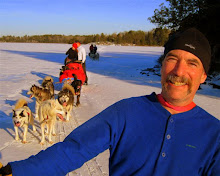
There are a number of ways to go travel in the winter Boundary Waters Wilderness while bringing along your full kit for a number of days and nights: with skis and pulk, snowshoes and toboggan or backpacking with snowshoes, and using a dog team The way I've been blessed with is by dog sled and ski. As a guide I teach the participants to mush the dogs (a big learning curve for the beginners) and then, with Wintergreen programs, the guides (typically 2) ski while the participants mush the dogs. One guide skis out in front of the first team (like the rabbit chased by the dogs) and the second guide skis among the sleds and helps with tangles and numerous other events that occur on the trail.
The camping trip is most generally a 5 night event that begins with the arrival of participants at the Wintergreen Dogsledding Lodge in the afternoon. Following dinner there are informational talks by the guides on topics such as clothing (we as guides check participants' clothing systems to ensure that they don't have cotton and have proper clothes for safety and comfort), diet and hydration. Many of the participants rent clothing and boots from Wintergreen. Fitting boots and liners to participants is always a time-consuming task. One important topic is using the sleep system that we provide, and participants try the Wiggy's brand sleeping bags and simple bivy sacks with foam pads while in the lodge. The sleep systems have to fit and the participant has to know where draw cords and zippers are so that they can adjust them in the dark. Tin cups, bowls with attached spoons, nalgene water bottles and insulating cozies are all handed out.
In the morning, before a guide-cooked breakfast, participants help to feed and water the dogs, then it's time for Dog Sled 101. The lecture-type course, in it's duration inside the lodge, covers teamwork and safety, terminology, sled and tack parts, dog psychology and voice commands,sled and lead musher roles, tips on the trail, and a host of other pertinent topics that come up during the course. I always have the feeling that the participants are in learning overload by the end of the short course, but most of them sort out the information once they're actively heading down the trail.
Following 101 we take a short woods walk to look at a variety of trees with participants being shown types of dead wood that makes good camp firewood and wood to avoid bothering to gather in the woods. Tents are looked at and put up, though often participants sleep out in the open without use of the tent or other shelter. Then we have a sled packing session followed by pushing the sleds down to the dog yard - all exciting activities preparatory to heading out from Wintergreen.
Even before the participants arrive at the lodge the guides are busily working to gather all gear, prepare the sleds, figure out menus, route and logistics.


Our skis at an island where we camped. The skis aren't jammed into the snow covered ice, but are actually "tripod-leaned using the ski pole straps. This helps to avoid chipping and delaminating the ski ends by crunching them through the snow onto the hard ice. The dogs are tied out on cable lines on the edge of the island. All dog poop is removed from the riparian edge.

This year, during the cold months Paul had a 4 person Empire Canvas Hybrid Snowtrekker tent with a titanium wood stove - a first for Wintergreen Dogsledding. Wintergreen always had cold camps with a 5 foot fire pan as the sole heat source; nylon mountaineering tents or else sleep units out in the open for sleeping the night away. The heated tent, during the dinner time was luxurious. The stove was a nice addition to cook on and the tent dried out clothing and warmed participants. An added benefit was the amount of wood that needed to be cut was a fraction of that needed for the long fire pan. In the case of heating the large kettle of lake water, we used a small lodge to lodge fire pan that was just big enough for heating the kettle. One drawback to the use of a heated tent was that once the tent was heated that is where participants congregated, not out around the campfire, under the starry firmament. We used 2 candle lanterns to light the tent.


A chickadee landing on a hand with the bait being some trail mix.


Hot water turns into vapor when thrown into the air at below zero temperatures.
Posted by Picasa

Friday, May 02, 2008

Winter Camping in the Boundary Waters, Part 2


In Part 1 of "Winter Camping in the Boundary Waters" I covered the basic steps before hitting the trail. Often the trips start out at Wintergreen Dogsledding Lodge and we leave the dog yard with loaded sleds, the guides driving the sleds down onto tie-out posts on White Iron Lake with the participants walking ahead of teams and guides on the narrow and sloped trail down to the lake. Other times the dogs are loaded into our large trailer with sleds put on top and all is hauled out to an end-of-road location.
The first day of participants mushing (handling and running) the dogs is usually chaotic but also quite amazing as most of the beginner dog mushers are able to put their classroom learning into the team that they are controlling with good effect. Yes, there are lost sleds and tangles due to inattention to the tenets taught to the participants, but basically I'm amazed that the trips begin as smoothly as they do.
Dog mushing is far removed from the lives of many of the participants, who are more used to their minds doing their work for them. in their everyday lives. Those who are involved in regular athletic pursuits and sports usually have an easier time of handling the dogs and trail occurrences.
We end up leaving in the afternoon and if the trip is in the short days of December, January or February we can only go for a few hours before we're forced to stop and set up camp. There is always the hustle of stopping and rushing to unpack the sleds, set up tents, spud in a water hole, gather firewood, set up the tripod and fire plate, and all of this after getting the dogs strung out on the cable picket lines and their harnesses taken off.
Food at breakfast and dinner is always hardy, with a high calorie count. Evening pizza tortillas as appetizers, the main course being stir fried shrimp and vegetables with sweet and sour sauce or meat balls and pasta with a spaghetti sauce followed by no-bake cheese cake. Breakfast may start with cinnamon and brown sugar on fried-in-butter bagels, followed by fried eggs and hash browns. Both meals are liberally lubricated and warmed by hot drinks: coffee or various teas, hot tang, cappuccino, or cocoa. The whole meal is a 2 hour affair with all participants hunkering down around the wood stove, or more typically the fire pan on sleeping pads arranged on top of logs, everyone soaking in the campfire's heat. Participants are discouraged from drinking liquids following the meal, so that they would be less likely to need to exit their sleeping bag in the middle of the night.
Feeding the dogs takes place after the people are fed, though the kibbled dog food is hopefully soaking up warm water for a long time before the dogs are fed.
Wintergreen's camping programs have always adhered to a hard-core image of cold camping (without heat other than a campfire) and for the truly rugged there is the discarding of even a tent - sleeping out, right on the ice and snow in the sleep unit. The guides generally sleep out or in the dogsled. I guess the dog sled pinpoints where the guide is, for the participant in distress, who is otherwise confronted with which black mound out on the snow is the guide. For the participant who is prematurely in distress just thinking about sleeping out in a winter camping trip, we tell them that they will surely not sleep too soundly the first night but that the second night everyone will sleep undisturbed... By the time the second night comes around, everyone is too committed deep in the wilderness if not too exhausted to bail on the trip.

The trips may break camp every day, traveling to a different area each day; or if the group and conditions dictate we may break camp and travel on the second day out, then base camp and do day trips. It is nice to travel to a new area, either for a day trip or to set up a new camp. The figuring out of a good place to camp is always a challenge - a place that has a good stake-out location for the dogs, that is sheltered from wind and has good firewood and a clear water source have to be considered.

When the camp site is chosen the first thing to be done is getting the stake-out cables out and unspooled and connected to trees or deadfalls. Usually the guides do this and the participants mind their dogs and sleds, which are typically on ice with nothing to anchor them to with the trailing lines. Then the dogs are put on the stakeout lines in order of teams. Once that is done the harnesses are removed. The sleds are hurriedly unpacked and camp is established, a water hole is chopped and spudded for water while some people forage for firewood and others set up tents and prepare the firepan and tripod with seating.
After the camp chores are done, the participants have time for themselves. This may mean taking a walk, or preparing for the night by organizing their tent or sleep system. There is always something to do and seldom are people idle.


Teams halted on a lake after going over a rough portage. On the first team, in the foreground, the "lead musher is keeping the dogs lined out while the "sled musher" keeps the brake on.

Around the campfire at night. The tripod is used to hang a large water boiler for drinking water. Each camper is a spoon, bowl and cup for all the eating that they will do at breakfast and dinner. Lunches are generally not cooked but consist of hot water in thermoses for ramen or other instant soups, hot drinks, jerky, string cheese, nuts, candy bars and other finger foods. If it is really cold we will sometimes have a noon campfire.
Notice how the snow and some ice has melted under the fire pan.


A camping sled all loaded on the trail along a bit of fast water near a portage trail.
Posted by Picasa