In Part 1 of "Winter Camping in the Boundary Waters" I covered the basic steps before hitting the trail. Often the trips start out at Wintergreen Dogsledding Lodge and we leave the dog yard with loaded sleds, the guides driving the sleds down onto tie-out posts on White Iron Lake with the participants walking ahead of teams and guides on the narrow and sloped trail down to the lake. Other times the dogs are loaded into our large trailer with sleds put on top and all is hauled out to an end-of-road location.
The first day of participants mushing (handling and running) the dogs is usually chaotic but also quite amazing as most of the beginner dog mushers are able to put their classroom learning into the team that they are controlling with good effect. Yes, there are lost sleds and tangles due to inattention to the tenets taught to the participants, but basically I'm amazed that the trips begin as smoothly as they do.
Dog mushing is far removed from the lives of many of the participants, who are more used to their minds doing their work for them. in their everyday lives. Those who are involved in regular athletic pursuits and sports usually have an easier time of handling the dogs and trail occurrences.
We end up leaving in the afternoon and if the trip is in the short days of December, January or February we can only go for a few hours before we're forced to stop and set up camp. There is always the hustle of stopping and rushing to unpack the sleds, set up tents, spud in a water hole, gather firewood, set up the tripod and fire plate, and all of this after getting the dogs strung out on the cable picket lines and their harnesses taken off.
Food at breakfast and dinner is always hardy, with a high calorie count. Evening pizza tortillas as appetizers, the main course being stir fried shrimp and vegetables with sweet and sour sauce or meat balls and pasta with a spaghetti sauce followed by no-bake cheese cake. Breakfast may start with cinnamon and brown sugar on fried-in-butter bagels, followed by fried eggs and hash browns. Both meals are liberally lubricated and warmed by hot drinks: coffee or various teas, hot tang, cappuccino, or cocoa. The whole meal is a 2 hour affair with all participants hunkering down around the wood stove, or more typically the fire pan on sleeping pads arranged on top of logs, everyone soaking in the campfire's heat. Participants are discouraged from drinking liquids following the meal, so that they would be less likely to need to exit their sleeping bag in the middle of the night.
Feeding the dogs takes place after the people are fed, though the kibbled dog food is hopefully soaking up warm water for a long time before the dogs are fed.
Wintergreen's camping programs have always adhered to a hard-core image of cold camping (without heat other than a campfire) and for the truly rugged there is the discarding of even a tent - sleeping out, right on the ice and snow in the sleep unit. The guides generally sleep out or in the dogsled. I guess the dog sled pinpoints where the guide is, for the participant in distress, who is otherwise confronted with which black mound out on the snow is the guide. For the participant who is prematurely in distress just thinking about sleeping out in a winter camping trip, we tell them that they will surely not sleep too soundly the first night but that the second night everyone will sleep undisturbed... By the time the second night comes around, everyone is too committed deep in the wilderness if not too exhausted to bail on the trip.
The trips may break camp every day, traveling to a different area each day; or if the group and conditions dictate we may break camp and travel on the second day out, then base camp and do day trips. It is nice to travel to a new area, either for a day trip or to set up a new camp. The figuring out of a good place to camp is always a challenge - a place that has a good stake-out location for the dogs, that is sheltered from wind and has good firewood and a clear water source have to be considered.
When the camp site is chosen the first thing to be done is getting the stake-out cables out and unspooled and connected to trees or deadfalls. Usually the guides do this and the participants mind their dogs and sleds, which are typically on ice with nothing to anchor them to with the trailing lines. Then the dogs are put on the stakeout lines in order of teams. Once that is done the harnesses are removed. The sleds are hurriedly unpacked and camp is established, a water hole is chopped and spudded for water while some people forage for firewood and others set up tents and prepare the firepan and tripod with seating.
After the camp chores are done, the participants have time for themselves. This may mean taking a walk, or preparing for the night by organizing their tent or sleep system. There is always something to do and seldom are people idle.
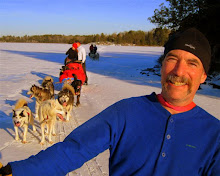
Teams halted on a lake after going over a rough portage. On the first team, in the foreground, the "lead musher is keeping the dogs lined out while the "sled musher" keeps the brake on.
The first day of participants mushing (handling and running) the dogs is usually chaotic but also quite amazing as most of the beginner dog mushers are able to put their classroom learning into the team that they are controlling with good effect. Yes, there are lost sleds and tangles due to inattention to the tenets taught to the participants, but basically I'm amazed that the trips begin as smoothly as they do.
Dog mushing is far removed from the lives of many of the participants, who are more used to their minds doing their work for them. in their everyday lives. Those who are involved in regular athletic pursuits and sports usually have an easier time of handling the dogs and trail occurrences.
We end up leaving in the afternoon and if the trip is in the short days of December, January or February we can only go for a few hours before we're forced to stop and set up camp. There is always the hustle of stopping and rushing to unpack the sleds, set up tents, spud in a water hole, gather firewood, set up the tripod and fire plate, and all of this after getting the dogs strung out on the cable picket lines and their harnesses taken off.
Food at breakfast and dinner is always hardy, with a high calorie count. Evening pizza tortillas as appetizers, the main course being stir fried shrimp and vegetables with sweet and sour sauce or meat balls and pasta with a spaghetti sauce followed by no-bake cheese cake. Breakfast may start with cinnamon and brown sugar on fried-in-butter bagels, followed by fried eggs and hash browns. Both meals are liberally lubricated and warmed by hot drinks: coffee or various teas, hot tang, cappuccino, or cocoa. The whole meal is a 2 hour affair with all participants hunkering down around the wood stove, or more typically the fire pan on sleeping pads arranged on top of logs, everyone soaking in the campfire's heat. Participants are discouraged from drinking liquids following the meal, so that they would be less likely to need to exit their sleeping bag in the middle of the night.
Feeding the dogs takes place after the people are fed, though the kibbled dog food is hopefully soaking up warm water for a long time before the dogs are fed.
Wintergreen's camping programs have always adhered to a hard-core image of cold camping (without heat other than a campfire) and for the truly rugged there is the discarding of even a tent - sleeping out, right on the ice and snow in the sleep unit. The guides generally sleep out or in the dogsled. I guess the dog sled pinpoints where the guide is, for the participant in distress, who is otherwise confronted with which black mound out on the snow is the guide. For the participant who is prematurely in distress just thinking about sleeping out in a winter camping trip, we tell them that they will surely not sleep too soundly the first night but that the second night everyone will sleep undisturbed... By the time the second night comes around, everyone is too committed deep in the wilderness if not too exhausted to bail on the trip.
The trips may break camp every day, traveling to a different area each day; or if the group and conditions dictate we may break camp and travel on the second day out, then base camp and do day trips. It is nice to travel to a new area, either for a day trip or to set up a new camp. The figuring out of a good place to camp is always a challenge - a place that has a good stake-out location for the dogs, that is sheltered from wind and has good firewood and a clear water source have to be considered.
When the camp site is chosen the first thing to be done is getting the stake-out cables out and unspooled and connected to trees or deadfalls. Usually the guides do this and the participants mind their dogs and sleds, which are typically on ice with nothing to anchor them to with the trailing lines. Then the dogs are put on the stakeout lines in order of teams. Once that is done the harnesses are removed. The sleds are hurriedly unpacked and camp is established, a water hole is chopped and spudded for water while some people forage for firewood and others set up tents and prepare the firepan and tripod with seating.
After the camp chores are done, the participants have time for themselves. This may mean taking a walk, or preparing for the night by organizing their tent or sleep system. There is always something to do and seldom are people idle.
Teams halted on a lake after going over a rough portage. On the first team, in the foreground, the "lead musher is keeping the dogs lined out while the "sled musher" keeps the brake on.

Notice how the snow and some ice has melted under the fire pan.


A camping sled all loaded on the trail along a bit of fast water near a portage trail.