Monday, October 08, 2007

Winter Anticipation in the Fall

A long time of not writing in this blog and a lot of water under the hull and snow under the skis!
After a summer drought we have had large quantities of rain in September and October. The trees were first stressed by a lack of water and now they have a lot of rain and wind to strip them of bright leaves.
My kayak season, which I thought was over is still not quite wound down with a safety course over in Munising this Friday, which Carl the outfitter is going to make monetarily worth my while by paying me for 2 days of work as well as $ for bringing down a tandem kayak from Sam at Copper Harbor.
It was a great season of back to back trips and many small adventures at Pictured Rocks, Grand Island and Isle Royale. I don't think that I've had quite such a busy season of trips in many years. The money flowed into the bank, though it is now flowing out for things that I've wanted like a Jotul wood stove, stainless chimney liner and work on my car and expenses with kids in college.

On this rainy day in October, with so many home chores to do... What am I thinking of, but my last winter's activity. The dog team guiding over in the Boundary Waters at Wintergreen Dog Sled Lodge. Not that it was all fun; a lot of work and the guides are run ragged for what they are paid - at least that's my perspective when I compare it to the sea kayak guiding. But in spite of stress factors and pay, it is a lot of fun, especially for the oldest guy in the whole operation. To be able to keep up on skis with guys that are half my age is awesome! And the $ do add up with tips padding the purse.
My back finally gave out on me during the end of the season with what ended up being a herniated L5 disc. The surgery was fairly non-intrusive with instant relief after a 6 week period of suffering. I doubt that I'll ever be quite as careless in the rest of my life at lifting. Thus far I have a good reminder in a dull sciatica throb in my butt when I don't lay right or go overboard on lifting.
So far this year, since I've been out of the kayak, I haven't spent much time out on rambles or paddles hereabout. Too many projects to complete and chores to do that have been left waiting during my busy summer afield. I did run the south branch of the Ontonogon River with my Pastor friend, Tom Anderson. It was a 2 day trip with rugged and raw weather and a lot of rocks.


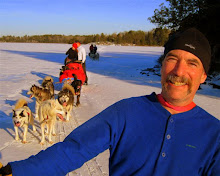
I am taking the dog team down from the dog yard at Wintergreen to White Iron Lake, below the lodge. where we set up a stake out yard. It looks like the one lead dog is glancing back to see if I was thrown off the sled as we just came out of the steep and bumpy trail. Wintergreen has Canadian and Greenland Inuit dogs, rather than the Alaskan Huskies that I mushed for many years. Inuits are slower (like little Sherman tanks) but are true work dogs for sledging.The trail down is too hazardous for the guests to be allowed to take the dogs and sleds down on their own. Usually the guides only mush the dogs over places too dangerous for the guests' safety, generally steep and bumpy places. Even so, many of the trips have multiple runaway sleds that the guides have to catch.


This is more like it...That's me on my skis up ahead of the dog teams - The guide is kind of like the alpha dog in the team. (S)he is followed by the dog teams and hopefully takes the right trail at the junctions, breaks trail when necessary, hooks up the teams, teaches the people all about the craft, prepares food, sets up camp and picks the proper places to stop and rest, etc.


This last picture shows a tired lead-dog-man (me) looking over the trail in the BWCAW while I'm gliding along. I may be looking at a beaver lodge over at the base of the woods ( right middle of the photo).


Posted by Picasa

Friday, October 27, 2006

Summer Memory in Autumn


Summer Memory In Autumn

All summer in a lake world of sun
Paddling my craft in the water
Above the sandstone and basalt floor
Striated, wind-etched, painted cliffs above.

All summer we wandered the wild waters
What we pictured in our minds, seen
In photo images and memories
Of refreshing food for the soul.

Gin-clear veridian-tinged world
Below our peaked bows sloshing
Below the rust and cobalt cliff faces
Robin-egg, tufted wool sky above all.

Northwind biting the end of the leaves
Fluttering and twisting down in icy waves
As heavy oak and maple slab off the cord
Warming now and when water is memory.
10 - 27 - 06


 Posted by Picasa

Monday, September 25, 2006

BOOK REVIEW: The Golden Spruce, by John Vaillant


THE GOLDEN SPRUCE: a true story of myth, madness and greed
Canadian author John Vaillant’s first "nature noir" work is set in British Columbia’s Queen Charlotte Islands. At it’s base it is the story of the dissolution of the Pacific Northwest’s temperate rain forest that is now being completed. Vaillant asserts that 90% of the American and 60% of the Canadian Pacific Northwest old growth forest is gone as of 2005. This Canadian author elucidates, in the course of his well researched work, what all of humankind loses as a result of the passing of this resource.

The Golden Spruce is much more than just a scientific and statistical treatise on the temperate rain forest; it delves into the lives of the Haida Indians and their spiritual attachment to the mutant Golden Spruce. This 300 year old chlorotic Sitka spruce tree, on the Queen Charlotte’s Nelson Island, was the only individually living organism that was told of in Haida stories. The story of K’iid K’iyaas—the golden spruce— was one of many Haida morality stories that was connected to an object on the land; but it was an individual living thing, not a rock or type of animal that legendarily got its characteristics through ancestral actions. Says Vaillant:

The golden spruce, in fact, was uniquely suited to bridge the gaps of time and culture. Trees are the only readily visible living things with such tremendous temporal reach, and no other tree was so strangely distinctive, so undeniably Other, that it could be recognized instantly by anyone, no matter what their culture, or at what point in history they came upon it. Left in peace, the golden spruce could have lived until the twenty-sixth century. [p. 157, The Golden Spruce ]

Most of the people who inhabit the nonfiction pages of the book are loggers, foresters and people involved in the forest product industry. Grant Hadwin, the chief character that The Golden Spruce centers around, is a logger and survivalist woodsman who, through many years of work in the logging industry, came to believe that the modus operandi of logging in the Pacific Northwest couldn’t be reconciled with the damage done to the environment.

In a carefully planned out scheme, debatedly psychotic Hadwin floats himself with chainsaw down the Yakoun River in winter weather and cuts the golden spruce so that it will fall with the first big wind. A letter sent to the media by Hadwin asserts that his reason for cutting the golden spruce was to get revenge on the giant logging company MacMillan Bloedel for their desecration of the old growth forest and waters that they have perpetrated in Canada. The golden spruce, that loggers had left due to its uniqueness was termed by Hadwin as the company’s "pet tree’. Author Vaillant sees the golden spruce and its cutting as much more: "Hadwin had cut down what may have been the only tree on the continent capable of uniting natives, loggers and environmentalists, not to mention scientists foresters and ordinary citizens in sorrow and outrage."
Hadwin’s response to the sorrow and outrage from others, as stated to a reporter: "When society places so much value on one mutant tree and ignores what happens to the rest of the forest, it’s not the person who points that out who should be labeled."

Hadwin disappears en route from the mainland across treacherous Hecate Strait by kayak for his trial on a charge of felony criminal mischief and illegal cutting of timber on crown land. His kayak and gear was found wrecked on a small island 75 miles from his departure point. Many local people still believe he is alive as this wasn’t the first time that he had gone missing.

Author Vaillant, through interviews of Hadwin’s co-workers and those close to him, develops plausible reasons for Hadwin’s actions and the unknown elements in Hadwin’s disappearance.
Vaillant’s interviews of many woods workers uncovers the mixed feelings that many of them have about the part they play in the destruction of the temperate rain forest. Says Vaillant, ‘The individual’s love of the woods exists in tandem with a collective industrial "rape and run" mentality that over time has left scoured valleys and fouled streams littered with machinery, fuel drums, old tires, and thousands of yards of rusted cable.’

If Grant Hadwin is still alive he must be disappointed that his attempts to draw attention to big logging’s destruction of old growth forest appear to have come to naught. Canada’s old growth forest continues to be clear cut . Hadwin’s "lesson" to the public appears to have been lost in the face of numerous eulogies and attempts to graft and clone another golden spruce.

Author John Vaillant rightfully leaves the reader without any hope to change our anthropocentric attitude toward humankind’s place on our planet. The temperate rain forest ecosystem is just one more victim in man’s "development of our resources." Posted by Picasa

Saturday, June 24, 2006

With the Conovers at North House Folk School


Garrett Conover paddling the new Penobscot birch bark canoe which Eric Simula, birch bark canoe builder said was the best crafted birch bark canoe he'd ever seen. The Conovers paid the Maine builder $10,000 to make it for them.

Alexandra demonstrating use of a pole . Later in the demonstration, she and Garrett double poled around in the harbor. With both of them poling in unison the canoe skimmed at high speed through the still water.

Garrett carrying a wanagan with tumpline. Later he added a large pack on top of the wanagan. He said he would generally carry 80 or 90 pounds per carry. The trick is to keep your spine aligned very straight on both the getting the load on your back (by using your knees to rotate the load up while your spine is kept rigidly straight) as well as throughout the portage.

The 2 blades of my northwoods paddles are sandwiched on my canoe spray deck with a Conover-made Northwoods paddle grip on top.

I got my cherry wood Northwoods paddle done up quite nicely and coated with multiple coats of tung oil. The Northwoods grip on it, with a long knob at the top feels natural in my hand. I finished it just in time to take it over to the North House Folk School Wooden Boat Show at Grand Marais, MN. Garrett and Alexandra Conover were the guest speakers and I wanted to take a workshop from them on the Northwoods stroke, which they have developed as a major part of their summer guiding repertoire. They are expert practitioners of traditional modes of travel in all seasons in the northwoods boreal forest. With wood and canvas canoes, wooden poles and paddles in the summer, wooden toboggan, snowshoes and cotton tents with wood stoves in the winter, they guide and teach about traditional modes of recreating on the land.
I made my northwoods paddle shorter than the more common 60+ inch paddle since I planned to use it in my solo canoe and not be using it from a standing position. After using their paddles as well as the ash one that I bought from Bourquin Boats, I like having the pronounced knob on the handle, though I need to thin down the mid section of the blade to get better flex. The workshops were great times for learning and spending time with the 2 guides of traditional northwoods skills. Alexandra paid me a compliment when she saw my new paddle by saying, "I wish that I could say that my first paddles looked as good as yours".
The weather mostly cooperated while in Minnesota except when I was on my way up the Gunflint Trail to Northern Lights Lake. The skies let loose with a deluge. Since the date was the 17th, and my birthday was June 19th I decided to move on. I had seen all that I cared to at the Wooden Boat show, had fine tuned my Northwoods stroke with the Conovers and camping was looking flooded and buggy. I decided to head over to Ely to stay the night at Wintergreen Lodge and visit with Paul and Susan Schurke. I arrived there at 10 PM, met a young graduate student staying at the lodge who was from Alaska. She was using the Wintergreen Inuit dogs in her Masters thesis, testing the canines after feeding them various wild meats; with a goal of being able to ascertain in wolf populations precisely what their eating habits are - if they are preying upon domestic livestock a simple stool test will determine if the wolf in question is the guilty one.
I talked to Paul about guiding some dog team trips this next winter. I'm going to have to train this 54 year-old body so that I'm in good enough shape for the trail! Posted by Picasa

Mnii Book Review: So Cold A Sky by Karl Bohnak


Among a number of interesting books that I’ve been reading, is So Cold A Sky: Upper Michigan Weather Stories by Marquette, Michigan meteorologist Karl Bohnak. This volume’s blend of weather and history since the arrival of the Europeans and recorded history has been a wonderful read for me. Like Bohnak, who was raised in southern Wisconsin, I have always been fascinated by weather, in particular severe weather in the north.

Karl surveyed a lot of missionary and settler journals and statistics from early upper Midwest military forts to write the over 300 page book. Included in the book is a detailed bibliography, glossary and index. There are numerous sidebars that delve further into the "rest of the story" concerning the people and natural phenomena that the book portrays so well. The reader is given an illuminating glimpse into the lives of most of the early explorers, such as Father Marquette, Alexander Henry, Henry Schoolcraft, and Peter White.
Much of the book features Lake Superior and the surrounding south shore land mass and the notable storms and weather patterns that have impacted humanity up to our 21st century. It is interesting to note the the weather over the last 50 years that I have been around and to try to recall from memory what I was doing and where I was during the time of these notable weather events.

With the wealth of interesting historical pictures and historical events as noted from original sources, So Cold A Sky makes for an unparalled reading treat for any Upper Peninsula buff.


Posted by Picasa

Wood Process, Spring 2006

Muir heading out to get another load of firewood.


Much of the energy expended over the latter portion of May, 2006 was involved in getting firewood at the MTU trails, which had been vastly widened a couple of years ago with a lot of seasoned wood still at various places on the trails. We mostly cut on the gas line easement and right in the midst of getting in loads of wood, Muir met Jeff Parker, head of trail maintenance at MTU. He invited us to help him and Jim Meese to remove a couple of giant maples. After doing that we were pretty well set with wood for this next winter as well as deep into the following one. I am still feeling the bone and tendon bruising effect of moving rounds too big to get moved without splitting into quarters first and having to roll up a plank into the truck with both Muir and I struggling. As of this date, I still have bucking to do and quite a volume to be split much smaller to fit in a stove.


Stacking the processed wood, much of it already seasoned and ready for next winter.


Bucking up a length of red oak. Then it will be split into size for the wood stove.
All ready to go into the stove. Posted by Picasa

Friday, May 12, 2006

Otter River Paddle May 6, 2006

At the put-in, we were trying to get up the courage to slide Dean down this clay mud bluff in his kayak to the river. Dean is wheelchair bound due to an injury he suffered when he fell out of a tree years ago.

Dean Juntunnen, Al Koivunnen, my son Muir, Kris Brown and myself paddled on the Otter River from Aspen Rd to past the bridge on M26. It seemed to be a long 13 miles, but some nice water and some fun little rapids with sharp turns and a number of log jams that Dean’s chainsaw with Muir operating made quick passage for our boats.


On the first log jam Muir wasn’t quite quick enough in moving off the jam when the tree he was cutting on came loose and gave him a couple of wet feet.
Some time later Muir's sunglasses slipped off his head and into the rushing river. I had told him previous to the loss that he didn’t need them, as it was a gray and rainy day. He didn't want to bother putting them away!
About 2/3 of the way we were going through some fast water at a sharp turn and Muir and Kris, in Muir’s 16 ft Old Town canoe hit a large snag on the outside of the turn and Kris lost his balance and capsized the canoe. Muir grabbed the chainsaw and then the canoe and they pulled it out to the bank where they could empty it and re-secure their gear.

The put-in was at the end of a dirt road and it had a high clay bank that the rain had turned into sticky goo. Getting Dean down the bank after roping down the canoes was complicated psychologically by the presence of a cross and debris of a car that had brought someone to their death after driving over the edge and down to the river. But we made it!

The take-out spot was also somewhat difficult as the State had "improved" the bridge by taking out the little access parking area and put crushed limestone rocks along the banks and steel guard rails that stopped access at both ends of the bridge. Dean knew a fellow just down the river who was willing to let us pull out at his property and also lend his 4-wheeler to pull Deans’s kayak, with him in it, from the river to the car and trailer.
We stopped for lunch at the MTU Forestry Club "Lodge" that was an old fish hatchery; an old brown-painted log building in run-down condition. All of the rivers and branches I had done with Dean this spring were running red with clay, and we would often pass large clay bluffs that were eroding into the river. The otter ran clear, though there were some clay banks. We arrived back at Houghton, just in time for Lynn’s dinner. Muir hovered over the woodstove for ½ an hour to warm himself thoroughly.It was early to bed after a full day on the Otter River.


Heading back to the car from the river. I portaged my canoe - this was too easy with the 4-wheeler pulling. Posted by Picasa